
 English

20 of The Most Famous Ashkenazi Jews
Originally Published by Brian in August 2023 and Updated by Nellian in May 2024.
Welcome to the intriguing world of Judaism, a religion and culture that has been around for millennia and still fascinates people all over the world. Judaism is a lively and varied society with a rich tapestry of history, traditions, and beliefs that has had a profound impact on the development of human civilization.
Judaism continues to be a steadfast light of knowledge, fortitude, and innovation, from the ancient teachings of the Torah to the contemporary expressions of religion and identity.
So fasten your seatbelts and get ready to go through the historic tales, profound wisdom, and lively traditions that make Judaism a timeless and alluring force in our constantly changing world.
1. Albert Einstein

Albert Einstein Head.jpg Photograph by Orren Jack Turner, Princeton, N.J. Modified with Photoshop by PM_Poon and later by Dantadd., Public domain, via Wikimedia Commons
Theoretical physicist Albert Einstein, who was born in Germany, is regarded as one of history’s finest and most important scientists. He is best known for creating the theory of relativity, but he also made significant contributions to quantum mechanics. As a result, he played a crucial role in the dramatic transformation of science’s perception of the natural world brought about by contemporary physics in the early decades of the 20th century.
“The world’s most famous equation” is his relativity-derived formula for mass-energy equivalence, E = mc2. His discovery of the law of the photoelectric effect, which was a crucial milestone in the development of quantum theory, earned him the 1921 Nobel Prize in Physics.
His writing is also renowned for its impact on scientific thought. In a 1999 survey conducted by the British publication Physics World of 130 of the world’s top scientists, Einstein came out on top. “Einstein” has come to mean “genius” due to his creativity and academic accomplishments.
Read On 10 Interesting Facts about Albert Einstein
2. Sigmund Freud

Sigmund Freud, by Max Halberstadt (cropped).jpg Max Halberstadt, Public domain, via Wikimedia Commons
Austrian neurologist Sigmund Freud is credited with developing psychoanalysis, a clinical approach to diagnosing and treating pathologies thought to result from psychiatric conflicts, and the unique theory of mind and human agency that emerged from it.
In the Moravian town of Freiberg, in the Austrian Empire, Freud was born to Jewish Galician parents. He earned his medical degree from the University of Vienna in 1881.
He received his habilitation in 1885 and was hired as a docent in neuropathology. In 1902, he was made an attached professor. After establishing his clinical practice in Vienna in 1886, Freud remained there and worked.
To avoid Nazi persecution, Freud fled Austria when Germany annexed it in March 1938. In exile in the UK, he passed away in 1939.
Read On Top 10 facts about Sigmund Freud
3. Golda Meir

Golda Meir 03265u.jpg Marion S. Trikosko, Public domain, via Wikimedia Commons
Israeli politician Golda Meir presided as Israel’s fourth prime minister from 1969 until 1974. She was the fourth elected female head of government or state in the modern era, the first and only female head of government in the contemporary Middle East, and the first and only female head of government in modern Israel. She’s been dubbed the “Iron Lady” of Israeli politics and is known for being approachable and persuading in person.
Meir and her husband moved to Kibbutz Merhavia in Mandatory Palestine in 1921. During the Second World War, she served in various important positions for the Jewish Agency.
After Moshe Sharett and other Yishuv leaders were detained by British authorities in 1946, Meir took over as interim director of the Jewish Agency’s Political Department. She contributed to the 1948 Israeli Declaration of Independence.
Meir was elected to the Knesset in 1949 and served as Labor Minister until 1956 when Prime Minister David Ben-Gurion elevated her to the position of Foreign Minister. She left the ministry in 1966 owing to health issues.
Read On Top 10 Interesting Facts about Golda Mei
4. Franz Kafka

Franz Kafka, 1923.jpg AnonymousUnknown author (see File:Kafka.jpg), Public domain, via Wikimedia Commons
Franz Kafka was a Czech novelist and short story writer who wrote in German and was located in Prague. He is recognized as one of the key authors of the 20th century. Realistic and fantastical themes are combined in his art.
In Prague, the capital of the Kingdom of Bohemia, then a part of the Austro-Hungarian Empire (now the capital of the Czech Republic), Kafka was born into a middle-class German-speaking Czech Jewish family. After finishing his legal studies, he began training as a lawyer but was soon forced to switch to working full-time for an insurance firm, leaving writing to his leisure time.
Despite being engaged to multiple women, he never wed. He passed away from TB at the age of 40 in obscurity in 1924.
Read On Top 10 Fascinating Facts about Franz Kafka
5. Marc Chagall

Marc Chagall 1941 cut.jpg Carl Van Vechten, Public domain, via Wikimedia Commons
The artist Marc Chagall was French and Russian. He was an early modernist who produced works in a variety of media, including paintings, drawings, book illustrations, stained glass, stage sets, ceramics, tapestries, and fine art prints. He was also affiliated with numerous important creative movements.
Chagall was born in 1887 into a Jewish family not far from Vitebsk, now in Belarus but then part of the Russian Empire’s Pale of Settlement. He commuted between Berlin, Paris, and Saint Petersburg before World War I. Based on his interpretations of Eastern European and Jewish folklore, he developed his blend and style of modern painting during that time.
6. Leonard Bernstein

Leonard Bernstein by Jack Mitchell.jpg Jack Mitchell, CC BY-SA 4.0, via Wikimedia Commons
American conductor, composer, pianist, music educator, author, and philanthropist Leonard Bernstein also played the piano. He was the first American conductor to win recognition on the global stage and was regarded as one of the most significant conductors of his time.
Donal Henahan, a music critic, referred to Leonard Bernstein as “one of the most prodigiously talented and successful musicians in American history”. He received several awards, including the Kennedy Center Honor, 16 Grammy Awards, the Lifetime Achievement Award from the Grammys, two Tony Awards, and seven Emmy Awards.
7. Shimon Peres
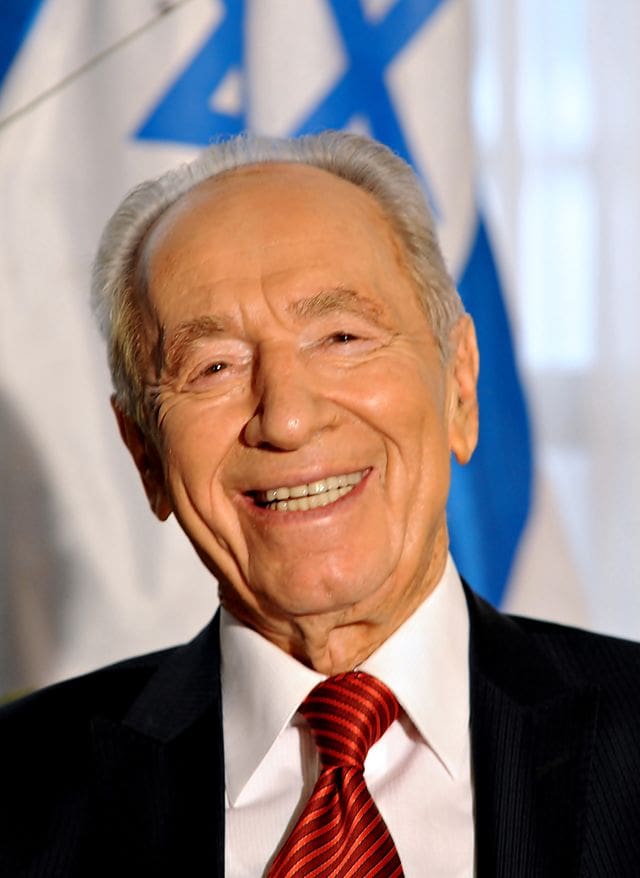
Shimon Peres in Brazil (cropped 2).jpg Elza Fiúza, CC BY 3.0 BR, via Wikimedia Commons
Shimon Peres was an Israeli politician who held the position of the ninth president of Israel from 2007 to 2014 and the eighth prime minister of Israel from 1984 to 1986. In a 70-year political career, he served in twelve ministries and as a representative of five political parties.
Except for a three-month break in early 2006, Peres was elected to the Knesset in November 1959 and served as a member until he was chosen as president in 2007. Peres is the Knesset member with the longest tenure in its history, having served for 48 years.
He was the oldest leader of the state in the world when he retired from politics in 2014 and was regarded as the final survivor of Israel’s founding generation.
8. Jonas Salk

Jonas Salk candid.jpg SAS Scandinavian Airlines, Public domain, via Wikimedia Commons
American virologist and medical researcher Jonas Edward Salk developed one of the first successful polio vaccines. He was raised in New York City and went to City College of New York and the School of Medicine at New York University.
Salk acquired a post at the University of Pittsburgh School of Medicine in 1947, and in 1948 he started research to count the many poliovirus varieties. Salk spent the following seven years researching and creating a polio vaccine.
9. Isaac Bashevis Singer

Isaac Bashevis Singer (Gotfryd).jpg Bernard Gotfryd, Public domain, via Wikimedia Commons
Jewish-American novelist, short-story author, memoirist, essayist, and translator Isaac Bashevis Singer was born in Poland. A few of his works have been transformed for the stage. He initially authored and published in Yiddish, then with the aid of editors and partners, he translated his works into English. In 1978, he received the Nobel Prize in Literature.
The leading figure in the Yiddish literary movement, he won two U.S. National Book Awards: one in fiction for his book A Crown of Feathers and Other Stories (1974) and one in children’s literature for his memoir A Day of Pleasure: Stories of a Boy Growing Up in Warsaw (1970).
10. Steven Spielberg

Steven Spielberg .jpg Gage Skidmore, CC BY-SA 3.0, via Wikimedia Commons
An American film director, producer, and screenwriter by the name of Steven Allan Spielberg. Situationally, his immediate family was either Reform Jewish or Orthodox Jewish. His grandmother Rebecca, who went by the maiden name Chechik, was from Sudylkiv, while his grandfather Shmuel Spielberg was from Kamianets-Podilskyi. Spielberg’s paternal grandparents were both Jews from Ukraine.
He is the most financially successful director in history and a key player in the development of the contemporary blockbuster. Numerous honors have been bestowed upon him, including the 2015 Presidential Medal of Freedom, the Kennedy Center Honor in 2006, the Cecil B. DeMille Award in 2009, three Academy Awards, two BAFTA Awards, four Directors Guild of America Awards, and the AFI Life Achievement Award in 1995.
11. David Ben-Gurion
He is honored as the national founder of the State of Israel and the country’s first prime minister. He was born in Poland, to Polish Jewish parents. While in Poland, Gurion fought for Jewish workers with might. He is remembered for opposing the anti-Zionist Bund that was gaining popularity in Warsaw in 1905.
Moreover, driven by a passion for his country, he left Poland for Palestine in 1906. He took his wife Rachel Nelkin, her mother, and his comrade on the journey.
In 1935, Ben-Gurion became the head of the Jewish Agency. Later he was selected as president of the Jewish Agency Executive and the de facto leader of the Jewish community in Palestine. Under his leadership, the movement pushed for an independent Jewish state in Mandatory Palestine.
12. George Gershwin

Carl Van Vechten, Public domain, via Wikimedia Commons
The American composer and pianist was of Ashkenazi Jewish ancestry. Though he was born in New York City, U.S. his grandparents came from Odessa in the Russian Empire (now Ukraine).
Besides, his compositions spanned jazz and classical genres. The opera Porgy and Bess (1935), is one of his notable works. It spawned the hit Summertime. The opera is an American cultural classic and is celebrated as one of the important American operas of the 20th century.
Gershwin’s other masterpieces include the orchestral compositions Rhapsody in Blue (1924) and An American in Paris (1928). Also, the songs Fascinating Rhythm (1924) and Swanee released in 1919. He is also famed for jazz standards like 1928’s Embraceable You and I Got Rhythm (1930). Most of his compositions have been adapted for use in many films and television shows to date.
13. Milton Friedman
Friedman was a renowned American economist and statistician. His contributions to the field of economics earned him the 1976 Nobel Memorial Prize in Economic Sciences.
He was born in Brooklyn, New York City in 1912 to Jewish immigrants from Beregszász in Carpathian Ruthenia, Hungary (now Berehove in Ukraine).
One of Friedman’s career highlights was his ideas about monetary policy, taxation, privatization, and deregulation. His thoughts influenced governments’ financial decisions during the 1980’s. His monetary theory was the guideline used by the US Federal Reserve System to respond to the 2007–2008 global financial crisis.
In a 2011 survey of economists by the Econ Journal Watch magazine, Friedman was named the second-most popular economist of the 20th century. He came second after John Maynard Keynes. The Economist eulogized him as “the most influential economist of the second half of the 20th century”.
14. Niels Bohr

https://pixel17.com, CC BY-SA 2.0, via Wikimedia Commons
The Danish physicist doubled as a philosopher and a promoter of scientific research. His ancestry was a wealthy Jewish banking family. His contributions to explaining the atomic structure and quantum theory earned him a Nobel Prize in Physics in 1922.
Better still, the Bohr model of the atom was named in his honor. During the 1930s, he helped refugees from Nazism making him an enemy of the Germans. In 1943 word reached Bohr that German authorities sought to arrest him. Following the reports, he fled to Sweden immediately.
Afterward, Bohr became a British ally, joining the British mission to the Manhattan Project. After the war, he called for international cooperation on nuclear energy which led to the formation of CERN (European Organization for Nuclear Research).
Furthermore, he was instrumental in the formation of the Research Establishment Risø of the Danish Atomic Energy Commission. In 1957, he was appointed as the first chairman of the international organization, Nordic Institute for Theoretical Physics.
15. Emma Goldman
This anarchist revolutionary, political activist, cum writer, hailed from an Orthodox Lithuanian Jewish family. Born in Lithuania, at the time within the Russian Empire, Goldman moved to the United States in 1885.
She was a force to reckon with in the anarchist political philosophy across North America and Europe during the early 20th century. In the early 1900s, she established herself as a champion for birth control, leading to several arrests.
Her anarchist journal Mother Earth was founded in 1906. Throughout her career, she was admired by freethinkers who dubbed her “rebel woman”. Further, her writing and lectures covered issues related to prisons, atheism, freedom of speech, and militarism. She was also outspoken on capitalism, marriage, free love, and homosexuality concerns.
16. Elie Wiesel

David Shankbone, CC BY 3.0, via Wikimedia Commons
He was a Romanian-born American writer, professor, and political activist. As a Holocaust survivor, Wiesel became a speaker on the subject. Boston University, where he was a professor of the humanities, established the Elie Wiesel Center for Jewish Studies to honor his legacy.
Furthermore, he was a strong defender of human rights. He influenced the establishment of the United States Holocaust Memorial Museum in Washington, D.C. He also served as a founding board member of the New York Human Rights Foundation.
He wrote over 55 books in French and English languages. One of his best-known works is his 1960 memoir, Night. The book narrates his experiences as a Jewish prisoner in concentration camps. He received the Nobel Peace Prize in 1986 in appreciation of his efforts.
17. Gustav Mahler
This Ashkenazi Jew was an Austro-Bohemian romantic composer. He gained acclaim as one of the best conductors of his time. His performances were banned in much of Europe during the Nazi era but revived after 1945.
Mahler’s most famous compositions are the Resurrection Symphony written between 1888 and 1894. It is also called Symphony No. 2. His Eighth Symphony was done in 1910 and is popularly known as the Symphony of a Thousand.
He inspired later composers such as Arnold Schoenberg, Alban Berg, Benjamin Britten, and more. In 1955, the International Gustav Mahler Society was established in his honor.
18. Bob Dylan

Alberto Cabello from Vitoria Gasteiz, CC BY 2.0, via Wikimedia Commons
The American singer-songwriter is a household name in popular culture with a career spanning six-plus decades. He grew up in Hibbing, Minnesota but his grandparents emigrated from the Russian Empire (now Odesa, Ukraine) to the United States in 1905. They fled the 1905 pogroms against Jews.
Dylan‘s songs Blowin’ in the Wind (1963) and The Times They Are a-Changin (1964) were his rise to the spotlight. They became anthems for civil rights and antiwar movements. He has sold over 145 million records, making him one of the best-selling musicians ever. He has also published books of paintings and drawings.
His awards include the Presidential Medal of Freedom, Grammy Awards, Golden Globe Awards, and Academy Awards. Besides, he won a Nobel Prize in Literature, a Pulitzer Prize, and induction into several music Halls of Fame.
19. Woody Allen
He is a celebrated American filmmaker, actor, and comedian. He has had a successful career in film for more than six decades. Allen was born in New York City in 1935. Yet his Ashkenazi Jewish roots are traced to his grandparents who immigrated to the U.S. from Austria and Lithuania.
The filmmaker prides himself in many accolades including Academy Awards, BAFTA Awards, Golden Globe Awards, and Grammy Awards. Two of Allen’s films have received the National Film Registry induction by the Library of Congress.
Annie Hall (1977) is one of his most successful films. The romantic comedy-drama won four Academy Awards. His other works include Take the Money and Run (1969), Manhattan (1979), Midnight in Paris (2011), Blue Jasmine (2013), and more.
20. Ruth Bader Ginsburg

Steve Petteway, Collection of the Supreme Court of the United States, Public domain, via Wikimedia Commons
She was an American lawyer and jurist born in 1933 in New York City, U.S. She inherited her Ashkenazi Jewish ancestry from her father who was a Jewish emigrant from Odesa, Ukraine.
Ginsburg is remembered for serving as an associate justice of the Supreme Court of the United States. She held the position from 1993 until she died in 2020.
Nicknamed “the Notorious R.B.G, she authored significant majority opinions during her tenure. Such as United States v. Virginia (1996), a case that ended male-only military admission in Virginia. Another example is Olmstead v. L.C. (1999), a case dealing with discrimination against people with intellectual abilities.
Jews have had a lasting impact on the globe via their rich history, extraordinary accomplishments, and lasting contributions. Their cultural fabric continues to inspire and enthrall, from antiquity to modern inventions. Jews are a wonderful example of the strength of tradition and advancement, embracing resiliency and variety. They serve as a reminder of the limitless potential that resides inside each of us due to their enduring legacy.
Planning a trip to Paris ? Get ready !
These are Amazon’s best-selling travel products that you may need for coming to Paris.
Bookstore
- The best travel book : Rick Steves – Paris 2023 – Learn more here
- Fodor’s Paris 2024 – Learn more here
Travel Gear
- Venture Pal Lightweight Backpack – Learn more here
- Samsonite Winfield 2 28″ Luggage – Learn more here
- Swig Savvy’s Stainless Steel Insulated Water Bottle – Learn more here
Check Amazon’s best-seller list for the most popular travel accessories. We sometimes read this list just to find out what new travel products people are buying.



.jpg)

.jpg)


.jpg)


.jpg)