 English


Hitler by Wikimedia Commons
10 Things That Hitler Did That Started The World War II
A worldwide warfare that ran from 1939 to 1945, the Second World War was one of the deadliest wars in human history. It involved the majority of the world’s countries, including all the big powers, and it’s believed that it caused the deaths of over 70 million people.
There were many causes of the war, but one of the main ones was the belligerent behaviour of Adolf Hitler and the Nazi government in Germany. Let’s take a look at the 10 things that Hitler did that led to the outbreak of World War II, including his violations of the Treaty of Versailles, the annexation of Austria, and the implementation of the Final Solution.
1. Violating the Treaty of Versailles

Treaty of Versailles by The British Government from Wikimedia Commons
One of the main causes of the start of World War II was Adolf Hitler’s violation of the Treaty of Versailles, which was ratified at the conclusion of World War I. The pact placed strict restrictions on Germany, such as caps on its war budget and reparations obligations to the Allies. Hitler, on the other hand, had long opposed the pact and considered it to be a disgrace to Germany.
He started to rearm Germany, expanding the military’s size and power beyond what was permitted by the treaty. Other European countries viewed this action as a threat and an obvious breach of international law. Hitler’s bold aims were demonstrated by his actions, which also paved the way for upcoming battles and eventually the disastrous world war. The Treaty of Versailles was designed to avert another world war, but one of the key causes of the first one to break out was Hitler’s breach of it.
2. Annexing Austria
The Anschluss, or annexation of Austria in 1938, was a crucial move in Adolf Hitler’s strategy to broaden the German Reich and take control of Europe. Hitler used the fact that Austria was a close neighbour with a sizable German-speaking populace as a justification for conquest.
The action was viewed as a grave danger to the authority of other European countries and a clear violation of international law. Hitler gained access to military facilities and essential materials through the annexation of Austria, which he would use to further his invasion of Europe. Little international opposition to the capture gave Hitler more confidence and enabled him to carry out his aggressive expansionist policies.
3. Demanding the Sudetenland

Sudetenland by German Federal Archives from Wikimedia Commons
One of the major incidents that contributed to the start of World War II was Adolf Hitler’s demand for the Sudetenland, an area in Czechoslovakia with a sizable German-speaking population. Hitler argued that he had to defend the Sudeten Germans because they were being abused. His true objective, however, was to enlarge German land and strengthen his hold on Europe. Hitler used the fact that Czechoslovakia had resisted his requests as justification for invading.
The authority of other European countries was directly threatened by this action, and it was also clearly illegal under international law. Hitler’s moves started a series of things that eventually resulted in the attack on Poland and the start of World War II.
4. Signing the Nazi-Soviet Pact
The Nazi-Soviet Pact, which Adolf Hitler unexpectedly signed in 1939, had a major impact on the start of World War II. The secret provisions that divided Eastern Europe into zones of influence were part of the non-aggression pact that the Soviet Union and Nazi Germany inked. Hitler was able to escape the possibility of a two-front conflict thanks to this action, which also enabled him to invade Poland without worrying about Soviet meddling. The agreement stunned the world, which had previously seen the Soviet Union as a possible ally against Nazi Germany.
Hitler’s readiness to abandon his own doctrine in order to further his expansionist objectives was also proven by the signing of the pact. In the end, the Nazi-Soviet Pact played a role in the rise of hostilities in Europe and helped pave the way for the catastrophic war that would come shortly after.
5. Invading Poland
Poland’s invasion was something Hitler had long considered doing, but the international community strongly opposed the idea. The invasion was an overt breach of international law as well as an aggressive act that endangered the security of other European countries.
In reaction to the invasion, the Allies, including Britain and France, declared war on Germany, ushering in the bloodiest war in recorded human history. Hitler’s invasion of Poland demonstrated his willingness to use force to further his expansionist objectives and paved the way for years of gruesome fighting that would result in millions of deaths and alter the path of human history.
6. Pursuing Lebensraum
The pursuit of Lebensraum, or “living space,” by Adolf Hitler was an essential factor at the start of World War II. To accommodate its expanding population and solidify its position as a major force in Europe, Hitler believed that Germany required more land.
As a result of this aggressive strategy, among other aggressive acts, Austria was annexed, the Sudetenland was demanded, and Poland was invaded. The Final Solution, a genocidal plan by Hitler to exterminate the Jewish people of Europe, was also brought about by his pursuit of Lebensraum.
7. Implementing the Final Solution
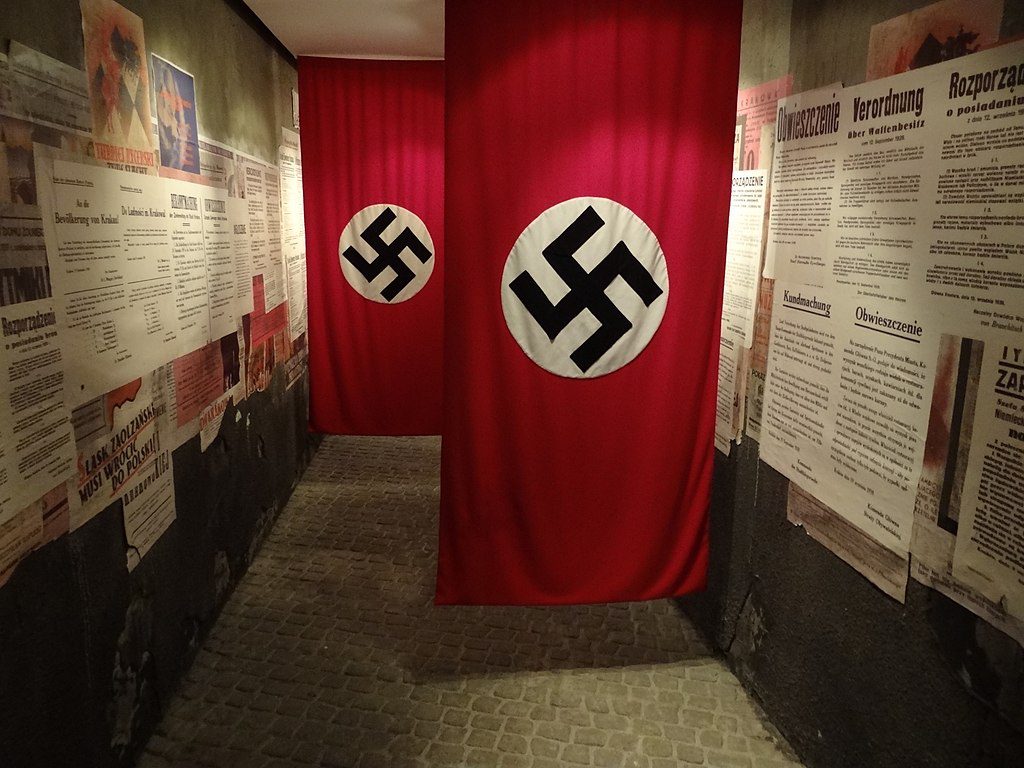
Nazi Swastika Flags by Adam Jones from Wikimedia Commons
Adolf Hitler’s implementation of the Final Solution, the Nazi policy of genocide against Jews and other “undesirable” groups, was a horrific atrocity that served to escalate World War II into one of the deadliest wars in human history. Jews were persecuted from the start of the Nazi era onwards as Hitler gained political clout. Six million Jews and millions of other people, including Roma, homosexuals, and people with disabilities, perished as a result of the Final Solution, which was implemented with the intention of methodically eradicating Jews throughout Europe.
8. Refusing to Surrender
One key reason why World War II dragged on was Adolf Hitler’s stubborn unwillingness to submit, even in the face of certain defeat. Hitler stayed unwavering in his conviction that Germany could still win the war even as Allied forces pressed in on Nazi Germany from several directions.
The suffering of those residing in Nazi-occupied areas was prolonged by this reluctance to submit, which resulted in the deaths of countless soldiers and civilians. A choice to use atomic weapons against Japan by the Allies, which resulted in the death of tens of thousands of people and the start of the nuclear era, was also made in part due to Hitler’s defiance.
9. Hitler’s response to the Normandy Invasion impacted the war

Normandy Invasion by Wikimedia Commons
The Normandy Invasion, which was initiated by Allied forces on June 6, 1944, marked a pivotal moment in the European conflict. The invasion, which featured the largest seaborne invasion in history, allowed the Allies to take control of France and start resisting Nazi Germany.
The course of the conflict depended heavily on Adolf Hitler’s response to the invasion. Hitler hesitated and delayed sending in reinforcements, enabling the Allies to consolidate their victories and widen their beachhead. The Allies were able to achieve a significant victory that paved the way for the eventual defeat of Nazi Germany as a result of this hesitation, which proved to be a critical error.
10. Committing Suicide

Adolf Hitler by Wikimedia Commons
The suicide of Adolf Hitler on April 30, 1945, signalled a significant turning point in World War II. Hitler decided to take his own life rather than risk being captured or defeated as Allied forces drew near Berlin and Germany was on the verge of disintegrating.
One of the main figures leading the war effort was driven out by his suicide, and the chaos his passing brought about aided in hastening the war’s end. Hitler’s death threw the German leadership into disarray, and the surviving high-ranking officials soon came to the conclusion that continuing their resistance was pointless. The deadliest conflict in human history came to a close a short while later when Germany unconditionally submitted to the Allies.
Planning a trip to Paris ? Get ready !
These are Amazon’s best-selling travel products that you may need for coming to Paris.
Bookstore
- The best travel book : Rick Steves – Paris 2023 – Learn more here
- Fodor’s Paris 2024 – Learn more here
Travel Gear
- Venture Pal Lightweight Backpack – Learn more here
- Samsonite Winfield 2 28″ Luggage – Learn more here
- Swig Savvy’s Stainless Steel Insulated Water Bottle – Learn more here
Check Amazon’s best-seller list for the most popular travel accessories. We sometimes read this list just to find out what new travel products people are buying.